
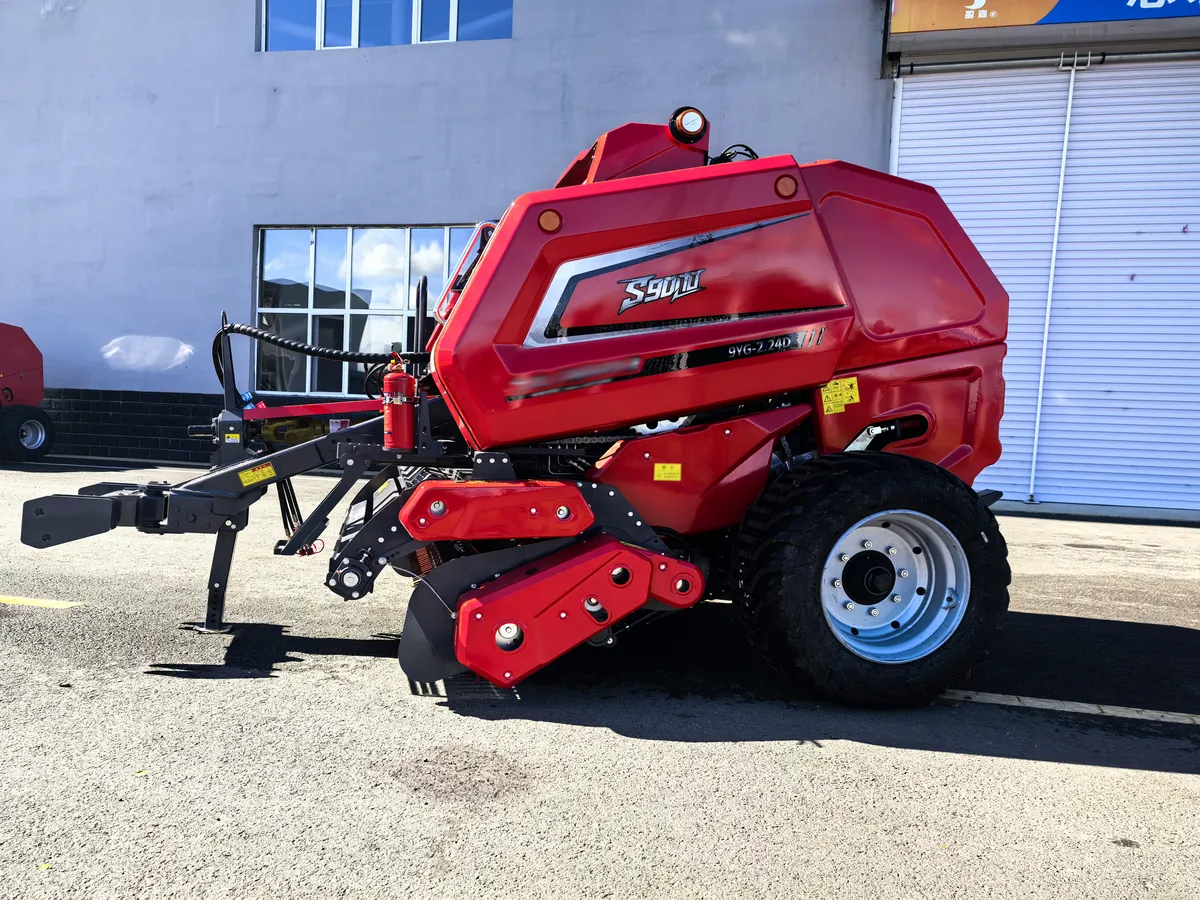
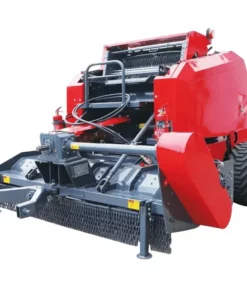
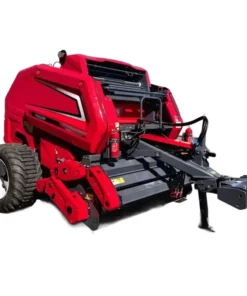
9YG-2.24D Round Baler (S9000) for Tractor

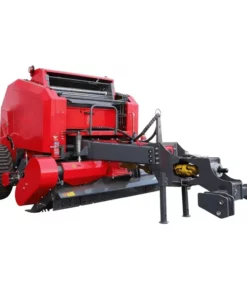
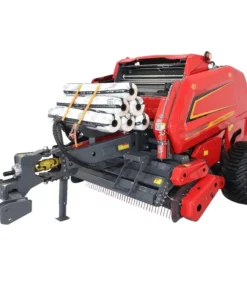
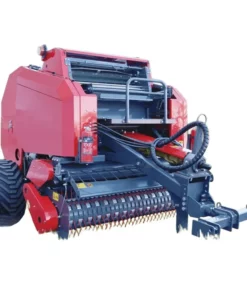
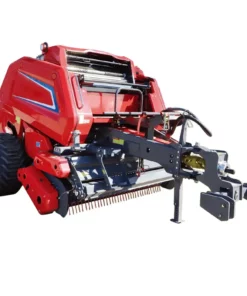
Discover the 9YG-2.24D Round Baler (S9000), a durable tractor round baler machine engineered for efficient hay and silage processing. Featuring a 2.24m pickup width, it delivers 40-100 bales per hour with adjustable density from 100-200 kg/m³, ensuring reliable performance for mid-sized farms at competitive round baler prices.
9YG-2.24D Round Baler (S9000) Overview
In the realm of agricultural machinery, the 9YG-2.24D Round Baler (S9000) stands out as a versatile and robust solution for farmers dealing with forage harvesting. This tractor round baler is specifically designed to handle a variety of crops, transforming loose hay, straw, or silage into compact cylindrical bales that are easy to store and transport. With its towed hitching method, it seamlessly integrates with standard tractors, making it an accessible choice for operations of different scales. The machine's emphasis on durability is evident in its construction, which incorporates high-quality materials to withstand the rigors of daily field work. Farmers appreciate how this round hay baler minimizes material loss during the baling process, preserving the nutritional value of the feed for livestock. Its compatibility with tractors ranging from 55 to 100 kW ensures that it can be powered efficiently without overburdening the equipment.
The 9YG-2.24D round hay baler excels in adaptability to diverse terrains and crop conditions. Whether you're working on flat pastures or slightly uneven ground, this compact round baler maintains consistent performance. Key elements like the tine-type pickup structure and roller-type compression mechanism contribute to its efficiency, allowing for smooth crop intake and uniform bale formation. The machine's ability to produce bales with diameters up to 1200 mm and widths of 1400 mm, which are ideal for standard handling equipment. This round baler machine not only boosts productivity but also reduces labor requirements, as it automates much of the baling process.
Product Specifications
If your farming needs require custom modifications or additional features beyond these specifications, please contact our team for tailored solutions to match your specific requirements.
| No. | Item | Unit | Specification |
|---|---|---|---|
| 1 | Model Name | / | 9YG-2.24D Round Baler (S9000) |
| 2 | Hitching Method | / | Towed |
| 3 | Pickup Width | mm | 2240 |
| 4 | Pickup Structure Type | / | Tine type |
| 5 | Feeding Mechanism Type | / | Fork and Roller Type |
| 6 | Compression Baling Mechanism Type | / | Roller Type |
| 7 | Compression Width | mm | 1400 |
| 8 | Compression Diameter | mm | Φ 1200 |
| 9 | Number of Compression Working Parts | Units | 18 (Roller) |
| 10 | Compression Roller Diameter | mm | Φ 222 |
| 11 | Bale Tying Method | / | Net Wrap |
| 12 | Matching Power | kW | 55–100 |
| 13 | Structural Mass | kg | 4262 |
| 14 | Power Output Shaft Speed | r/min | 720 |
| 15 | Overall Dimensions (L × W × H) (Working State) | mm | 4240 × 3010 × 2450 |
| 16 | Bale Density Control | / | Sensor Control |
| 17 | Bale Dimensions (Diameter × Width) | mm | Φ 1300 × 1400 |
| 18 | Bale Density | kg/m³ | 100–200 |
| 19 | Productivity | Bales/h | 40–100 |
| 20 | Wheelbase | mm | 2600 |
| 21 | Working Speed | Km/h | 5–35 |
| 22 | Net Wrap Specification (L × W) | / | 2000 × 1.4 m/bale |
Features of the 9YG-2.24D Hay Round Baler (S9000)
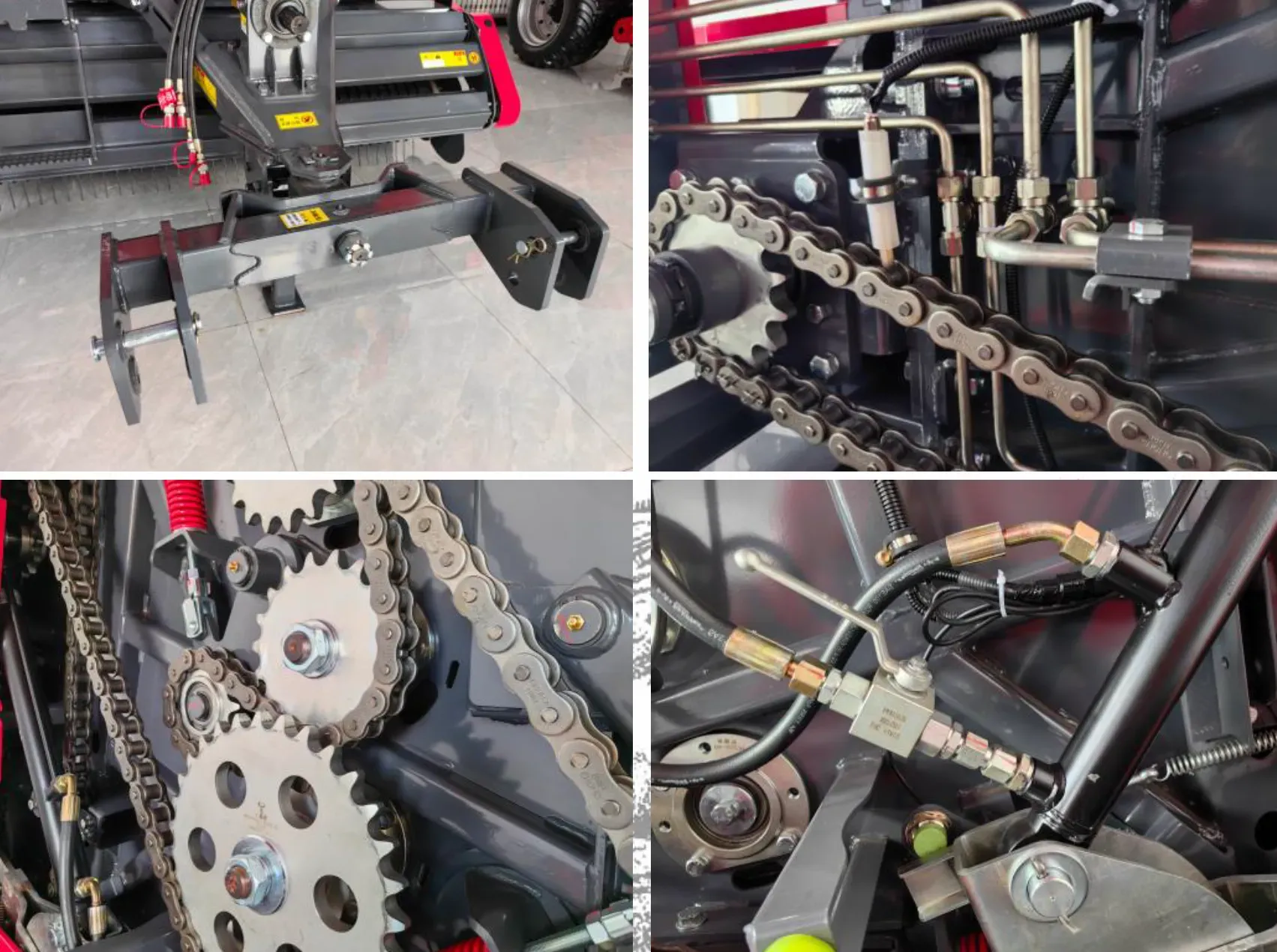
- Enhanced Compression with Dual-Side Heavy-Duty Chains
The machine incorporates a robust dual-side 20 A heavy-duty chain setup in its rear compartment, which boosts overall compression force during the baling process. This design allows for the creation of exceptionally dense round bales weighing between 500 and 1000 pounds, directly addressing farmers' needs for compact, high-quality forage storage that reduces spoilage and eases handling in various field conditions. Operators report noticeable improvements in bale uniformity, making it easier to stack and transport without compromising on the nutritional content of hay or silage. - Superior Bale Density for Practical Farming
By leveraging the reinforced chain mechanism, this baler achieves greater pressure application, resulting in bales that hold together firmly even under rough transport or long-term storage. This feature not only fulfills customer expectations for heavier, more stable outputs but also minimizes material loss during operation, which is crucial for mid-sized farms aiming to maximize yield from each harvest cycle. In practice, users find that these denser bales lead to better space utilization in barns, cutting down on labor time and associated costs. - Innovative Traction Device with High Torque Capacity
Equipped with a new traction system delivering a maximum torque of 1000 Nm, the baler ensures reliable power transfer from the tractor, enabling smooth performance across demanding terrains. This setup prevents slippage and maintains consistent speed, which is essential for completing large-scale baling tasks without interruptions. Farmers appreciate how this torque level supports heavier loads, contributing to overall durability and reducing wear on connected equipment over extended use. - Adjustable Inclination Angle for Versatile Operation
The traction device's adjustable inclination angle allows operators to fine-tune the baler's position relative to the ground, adapting to slopes or uneven surfaces that would otherwise hinder progress. This flexibility overcomes limitations in traditional towed balers, where fixed horizontal adjustments often cause delays or incomplete coverage. In real-world scenarios, such as hilly pastures, this means faster completion of jobs, with less strain on the tractor and improved safety for the driver during maneuvers. - Wide Lateral Steering Angle for Maneuverability
Featuring a 100-degree lateral steering angle, the machine provides exceptional turning capability, making it simpler to navigate tight corners or around obstacles in the field. This enhances operational flow, especially in irregularly shaped plots where quick directional changes are needed to avoid missing patches of crop. Combined with the tractor's maximum 30-degree lateral tilt tolerance, it ensures stability on inclines, preventing tipping risks and allowing for confident use in diverse agricultural settings.
Working Principle of the Round Baler Machine
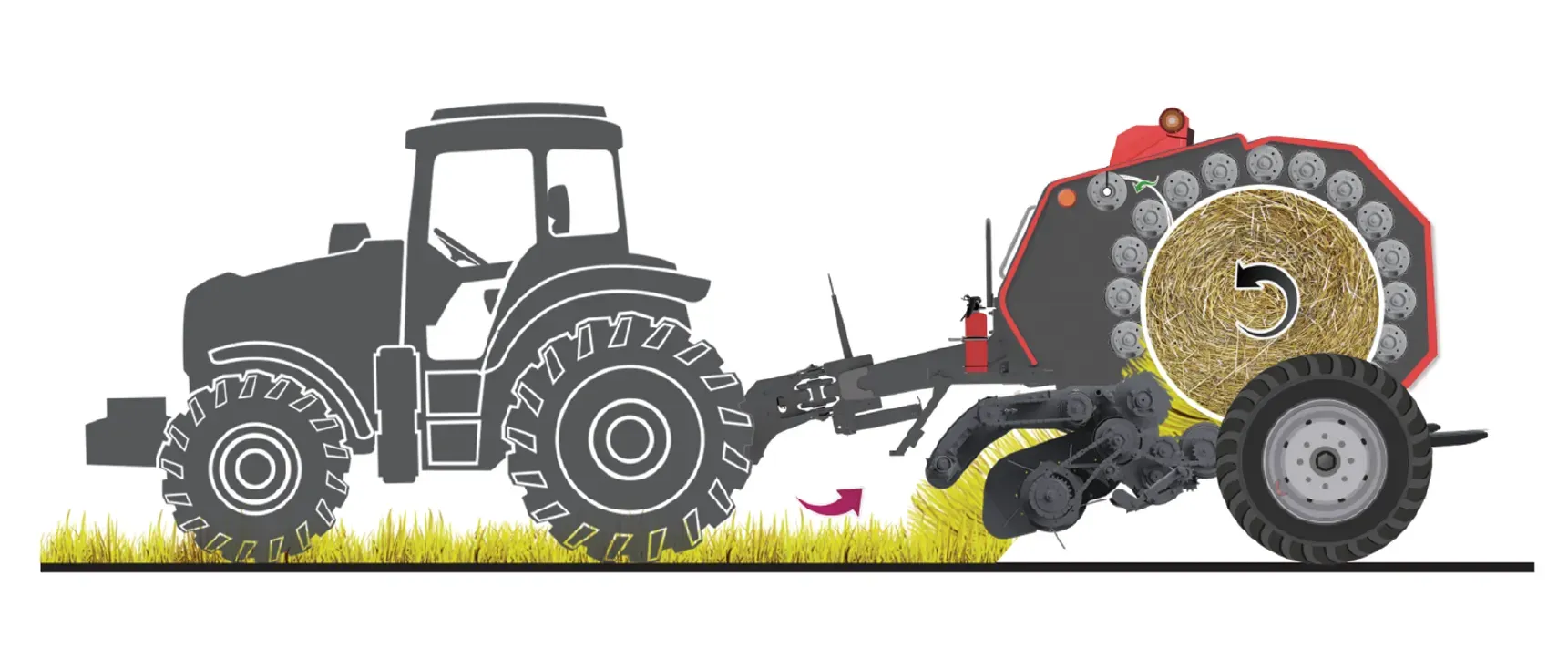
The operation of a PTO-driven round baler machine relies on a coordinated sequence of mechanical actions powered by the tractor's power take-off system. Initially, the process starts with the tractor's PTO shaft connecting to the baler's gearbox, which receives rotational energy from the engine. This input power, typically rotating at 540 or 1000 RPM, undergoes speed reduction within the gearbox to generate higher torque necessary for handling heavy loads. The adjusted power then drives the pickup assembly, where rotating tines or reels lift cut forage such as hay or straw from the ground and direct it upward into the feeding mechanism. This step ensures a steady flow of material, minimizing blockages by evenly spreading the crop across the intake area as the tractor advances at a controlled speed of 5 to 35 km/h.
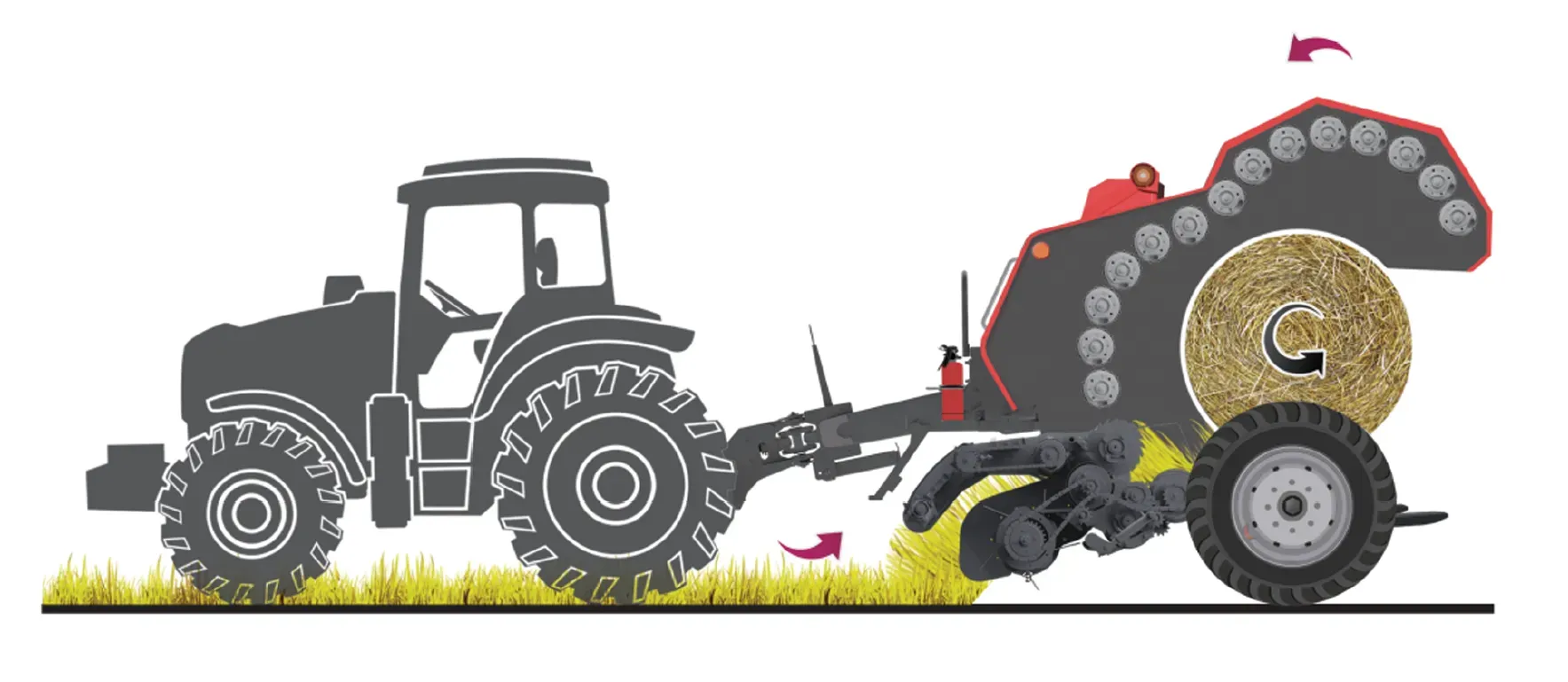
Once the forage enters the baling chamber, a combination of forks and rollers takes over to align and push it inward. The chamber, often equipped with fixed and movable rollers arranged in a circular pattern, begins compressing the material through continuous rotation. Belts or chains wrap around the forming bale, applying consistent pressure to build a dense core while additional layers accumulate. Integrated sensors monitor the bale's density in real time, enabling operators to make manual or automatic adjustments via hydraulic controls to accommodate varying moisture levels—drier hay might require tighter compression to reach 100-200 kg/m³, whereas silage benefits from looser settings to preserve fermentation qualities. This phase is critical for producing uniform bales, typically measuring 1200-1300 mm in diameter and 1400 mm in width, which enhances storage efficiency and reduces nutrient loss.
As the bale reaches the desired size, the system triggers the wrapping stage. A net or twine dispenser activates, encircling the bale several times to secure its shape and prevent unraveling during handling. The wrapping material, often a 2000 x 1.4 m net per bale, is fed automatically, ensuring quick coverage without halting the machine. Finally, upon completion, the chamber opens via hydraulic rams, and the ejection mechanism—powered by the same PTO-driven components—gently rolls the finished bale onto the field. This release resets the chamber for the next cycle, allowing uninterrupted operation that can yield 40-100 bales per hour depending on crop conditions and tractor power (55-100 kW).
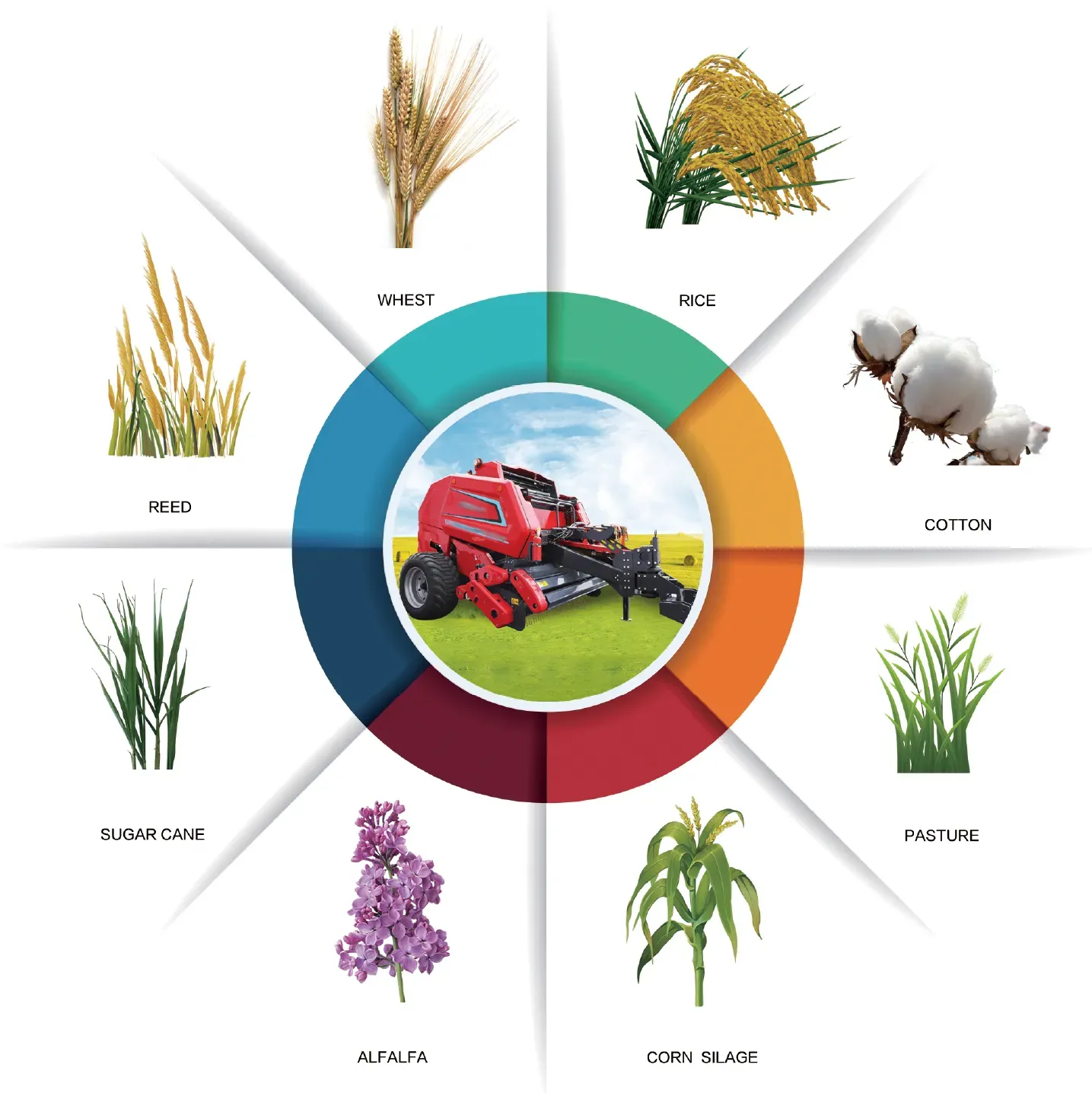
Round Hay Baler Application Areas
- Wheat Straw Baling
In wheat farming regions, round hay balers efficiently collect and compress post-harvest straw residues into dense cylindrical bundles, facilitating easy transportation to livestock facilities or biofuel plants. This process minimizes field clutter, supports soil conservation by reducing erosion, and enables farmers to monetize byproducts through sales to bedding manufacturers or energy producers, enhancing overall operational sustainability. - Rice Paddy Residue Management
Round balers are utilized in rice cultivation areas to bundle leftover stalks after grain removal, preventing waterlogging in paddies and promoting quicker field preparation for subsequent crops. By forming compact rolls, these machines aid in converting residues into animal feed or mulch, thereby improving nutrient recycling and reducing the environmental impact from burning, which is common in some Asian agricultural practices. - Corn Silage Production
For corn silage, hay round balers compact chopped maize plants into airtight bales that preserve moisture and nutritional value for dairy cattle feeding during off-seasons. This application ensures high-density storage with minimal spoilage, allowing large-scale operations to maintain consistent fodder supply, while the baler's adjustable settings accommodate varying crop densities to optimize fermentation processes. - Pasture Grass Harvesting
In pasture management, round hay balers gather excess grass growth from grazing lands, creating uniform bales suitable for winter storage or export to arid regions lacking forage. This method preserves hay quality by shielding it from weather exposure, supports rotational grazing strategies, and contributes to land health by preventing overgrowth that could lead to pest infestations or reduced biodiversity. - Reeds and Wetland Vegetation Control
Round balers handle reeds from wetland ecosystems by compressing them into manageable bales for uses in thatching, paper production, or erosion control barriers. This application aids in maintaining waterway flows, prevents invasive spread, and provides economic value through harvesting natural resources, particularly in coastal or riverine areas where manual collection would be inefficient and labor-intensive. - Cotton Stalk Processing
After cotton harvesting, hay round balers bundle fibrous stalks into rolls for conversion into pellet fuel or livestock bedding, addressing waste disposal challenges in cotton-growing belts. The dense baling reduces transportation costs, minimizes fire hazards from scattered residues, and integrates with sustainable farming by returning organic matter to soils or utilizing it in industrial applications like particleboard manufacturing. - Sugarcane Bagasse Utilization
In sugarcane fields, balers compact bagasse—the fibrous residue post-juice extraction—into bales for efficient storage and transport to bioenergy facilities or animal feed mills. This practice enhances mill efficiency by clearing processing areas swiftly, supports renewable energy initiatives through biomass conversion, and reduces greenhouse gas emissions compared to open-field decomposition or incineration. - Alfalfa Forage Baling
Round hay balers are essential for alfalfa crops, compressing nutrient-rich leaves and stems into high-quality bales that retain protein levels for premium livestock feed markets. This application allows multiple cuttings per season with rapid field recovery, ensures consistent bale weights for commercial trading, and aligns with precision agriculture by enabling moisture monitoring to prevent mold during long-term storage.
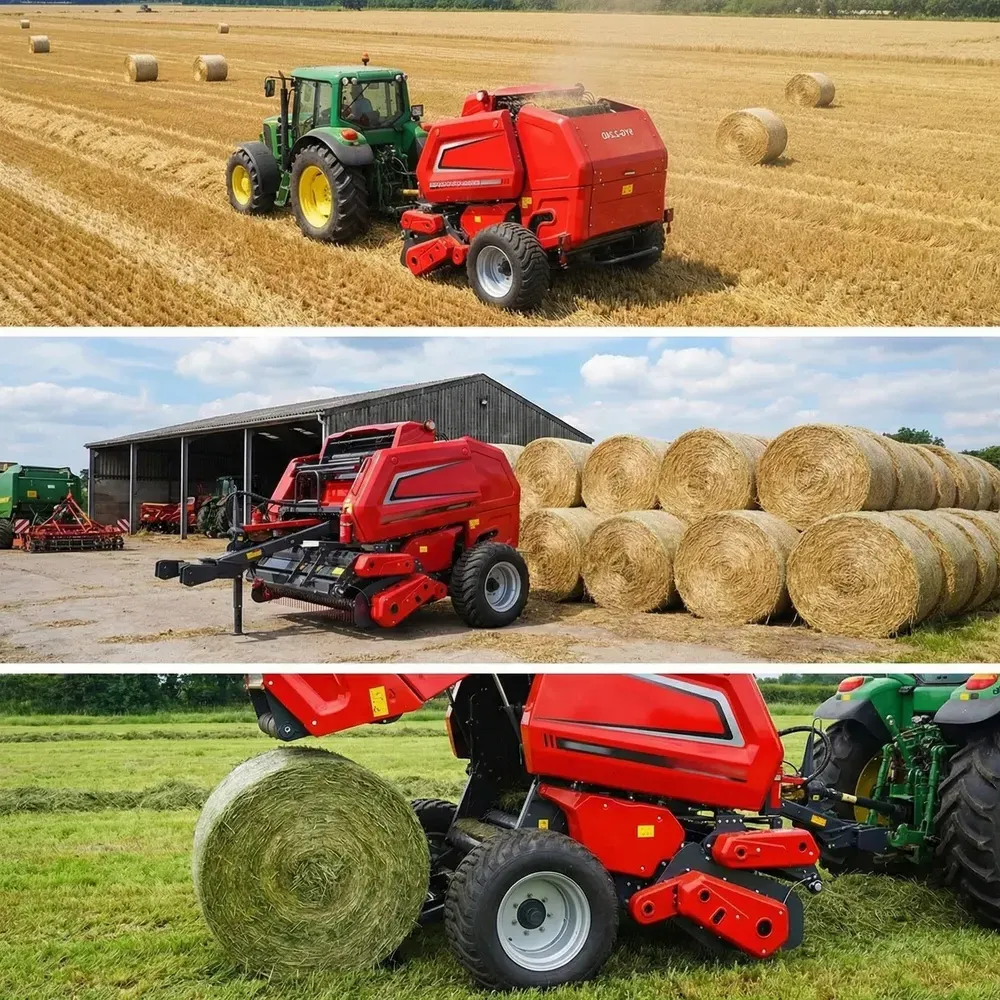
Common Troubleshooting of Round Hay Baler Machine
- Uneven Bale Formation
Operators often encounter bales with inconsistent shapes or densities during hay processing, which can stem from improper tension settings or worn belts. To address this, inspect and adjust the hydraulic pressure according to the machine's manual, replace any stretched belts, and ensure even distribution of crop material by varying tractor speed across the field, thereby improving overall bale quality and reducing waste. - Chamber Blockages
Frequent clogs in the baler chamber disrupt workflow and strain components, typically caused by overly wet hay or debris accumulation. Clear obstructions by halting operations, manually removing buildup from rollers and tines, and verify that the pickup height is set correctly to avoid overloading; regular cleaning after each session prevents recurrence and maintains smooth material flow. - Net Wrap Failures
Issues with net wrapping, such as splitting or incomplete coverage, arise from degraded material or misalignment in the feeding mechanism. Examine the net roll for damage, realign the feed guides if shifted, and test tension adjustments to ensure even application; sourcing high-quality nets and storing them properly extends their usability and minimizes downtime in the field. - Bale Bursting After Ejection
Bales that split open post-ejection indicate problems like excessive internal pressure or worn compression rollers. Check roller alignment and surface condition for signs of wear, recalibrate density controls to match crop moisture levels, and inspect the wrapping system for adequate layers; these steps help produce stable bales suitable for long-term storage. - Belt Tracking Misalignment
Belts shifting to one side during operation can lead to uneven wear and operational halts, often due to unbalanced tailgate latches or damaged splices. Assess the idler rollers for proper positioning, straighten any bent components, and confirm uniform tension across all belts; performing these checks before starting a new field promotes consistent performance. - Twine Arm Malfunction
The twine arm failing to reset or extend properly hinders the tying process, commonly linked to hydraulic leaks or debris in linkages. Inspect hoses for fluid loss, clean pivot points and lubricate them thoroughly, and manually cycle the arm to identify binding; routine hydraulic fluid changes enhance reliability during peak harvest periods. - Excessive Vibration
Unusual shaking in the machine signals driveline imbalances or loose fasteners, which could escalate to major breakdowns if ignored. Tighten all bolts and connections, align the PTO shaft with the tractor's output, and balance rotating parts; conducting vibration tests at low speeds allows early detection and safer extended use. - PTO Engagement Problems: Failure of the power take-off to activate or maintain power transfer disrupts baling entirely, often from improper hitching or clutch slippage. Ensure secure attachment points, check clutch adjustment for correct engagement, and verify tractor RPM matches baler requirements; these verifications support uninterrupted power delivery and protect drivetrain components.
- Knotter System Errors
Knotters missing ties or producing weak knots result from dirt buildup or worn bill hooks, affecting bale integrity. Clean the knotter assembly with compressed air, replace dull hooks as needed, and adjust twine disc gaps precisely; consistent monitoring during operation upholds tying accuracy for marketable bales.
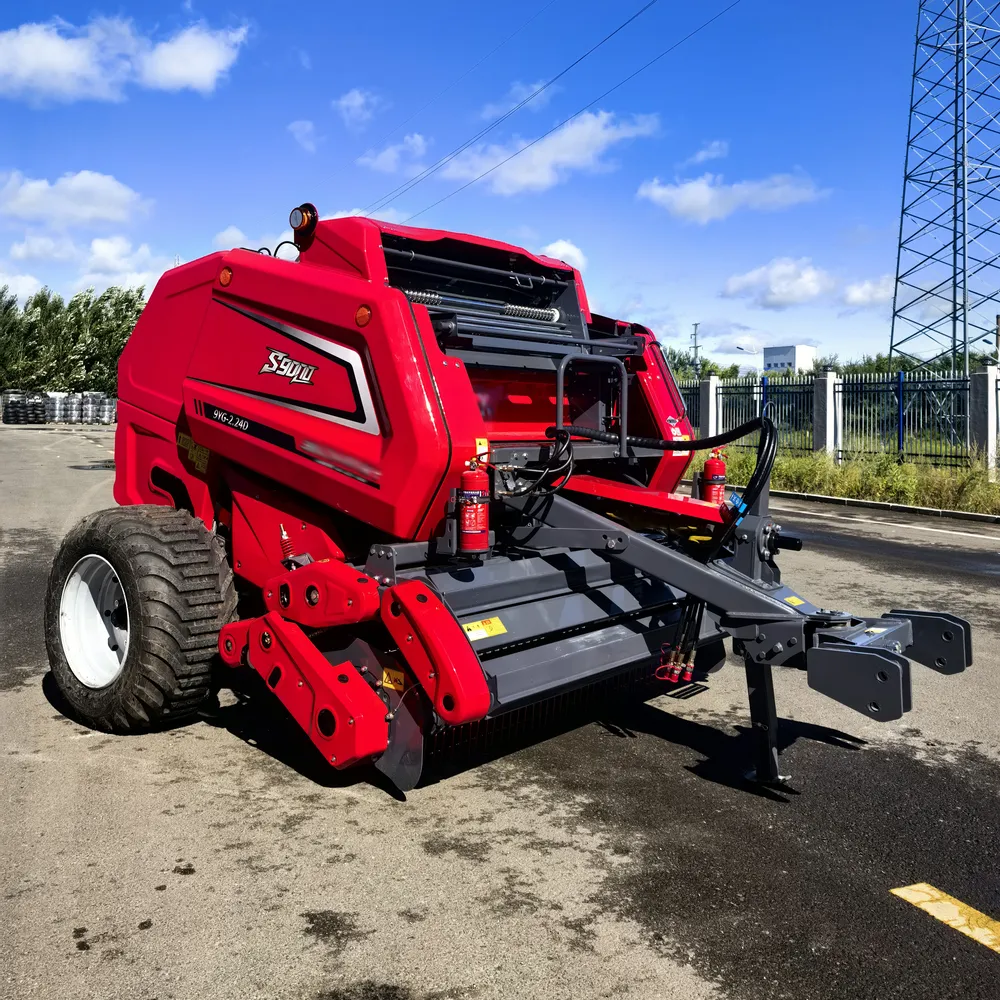
FAQ
Q: What is the ideal tractor power for the round baler for tractor?
A: Farmers selecting a tractor round baler like the 9YG-2.24D model should aim for engines rated between 55 and 100 kilowatts to ensure sufficient torque for steady performance across varied terrains. This range supports efficient operation without overburdening the machinery, making it compatible with many standard tractors used in hay production.
Q: How do I adjust bale density on this hay round baler?
A: To modify bale density in the round hay baler machine, access the onboard sensor control interface and input values ranging from 100 to 200 kilograms per cubic meter, tailored to specific forage types such as dry grass or moist silage. This adjustment helps optimize storage and transport, preventing issues like spoilage in silage round baler applications.
Q: What are common round baler sizes produced by this machine?
A: The compact round baler generates bales up to 1300 millimeters in diameter by 1400 millimeters wide, dimensions that align well with typical handling tools and storage facilities. These round baler sizes facilitate easy stacking and reduce transportation costs, ideal for operations dealing with diverse crop volumes.
Q: Is this round hay baler for sale suitable for small farms?
A: Absolutely, the round hay baler for sale features a space-saving design and outputs 40 to 100 bales per hour, accommodating farms of modest size while delivering reliable results. Its adaptability makes it a practical choice for limited-acreage setups focused on efficient forage management without requiring extensive resources.
Q: How often should I replace round baler belts?
A: Examine round baler belts following every 500 bales processed, and proceed with replacement upon detecting signs of fraying or reduced tension to maintain uninterrupted function. Regular checks prevent breakdowns during peak seasons, extending the lifespan of the round baler machine and ensuring consistent bale wrapping.
Q: What maintenance is needed for silage round baler use?
A: For silage round baler operations, perform daily chamber cleanings to remove residue, apply lubrication to moving parts each week, and inspect hydraulic lines monthly for leaks or wear. These routines safeguard against corrosion from moist materials, promoting longevity and peak efficiency in demanding wet crop environments.
Q: What is the round baler price range?
A: Round baler price typically falls between 15,000 and 20,000 US dollars, influenced by factors like regional availability, optional enhancements, and customization for specific needs. This investment reflects durable construction and advanced features, offering value for producers seeking long-term reliability in their equipment.
Q: Can this round baler machine handle wet crops?
A: Yes, the round baler machine excels with damp forages thanks to customizable compression settings that manage excess moisture and avoid clumping during the baling process. This capability is particularly beneficial for silage production, where preserving nutritional content requires careful handling of humid conditions.
Q: How to install the round baler pto shaft?
A: Begin by aligning the round baler PTO shaft with the tractor's output, fasten it securely using provided couplers, apply grease to joints for smooth rotation, and conduct a low-speed trial to confirm proper engagement. This setup ensures safe power transfer, minimizing vibration and wear over time.
Q: What makes this the best round hay baler?
A: Distinguished as the best round hay baler through its robust build, high operational efficiency, and versatile adaptations for various field conditions, the model incorporates sensor technology for precise control. These elements combine to deliver superior bale quality and reduced downtime compared to standard options.
Q: How to troubleshoot compact round baler jams?
A: When facing jams in a compact round baler, immediately power down the unit, manually dislodge accumulated debris from the intake and rollers, then reset the electronic sensors before resuming. This approach resolves blockages swiftly, preventing damage and restoring normal function in hay or straw processing.
Q: Are parts for round straw baler readily available?
A: Certainly, EVER-POWER maintains an extensive inventory of components for the round straw baler, enabling rapid shipment to customers worldwide. This accessibility supports quick repairs, minimizing interruptions and upholding productivity for users handling straw or similar residues in agricultural settings.
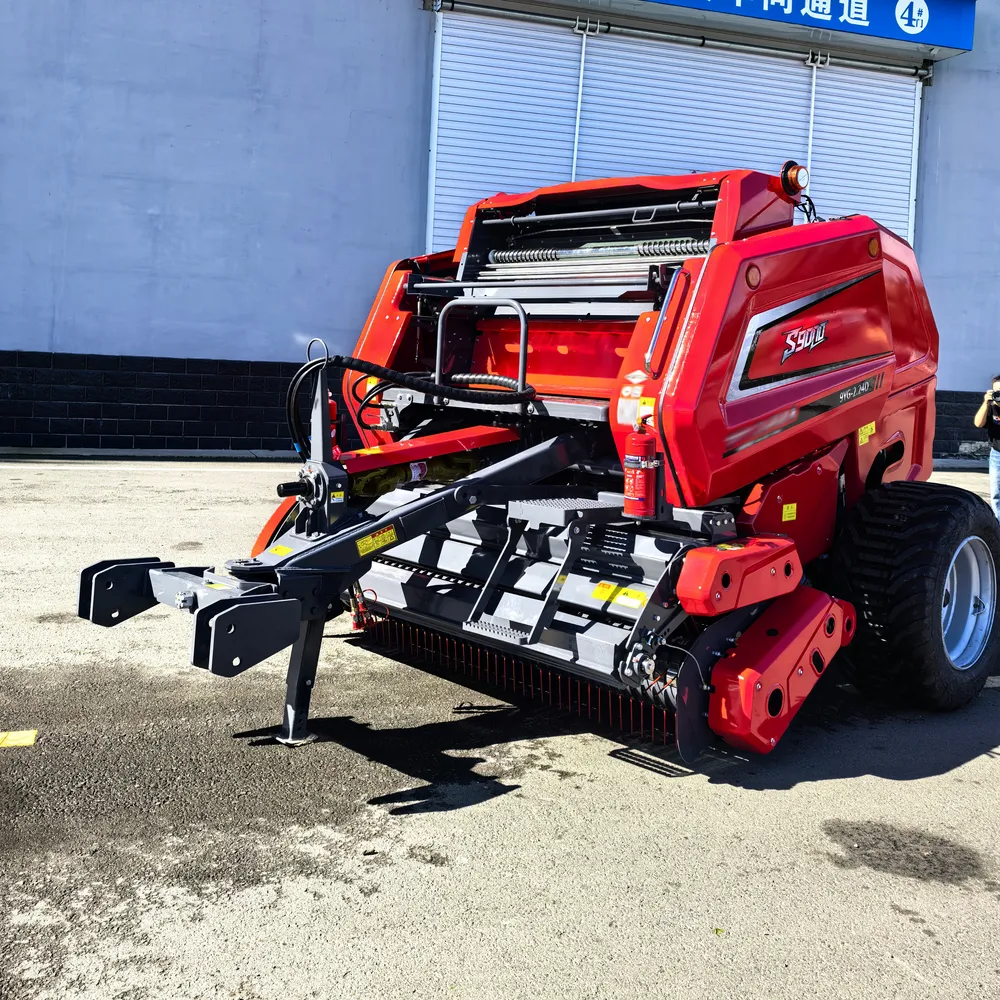
Customer Reviews
Elena Vargas, Cattle Rancher, Argentina
"Picked up this round baler for tractor last year to handle our massive alfalfa fields, and it's been a game-changer with the 2240mm pickup width grabbing everything cleanly. No more wasting time on manual fixes; the compact round baler spits out perfect 1200mm bales even in windy conditions. Service folks sorted a belt tweak remotely—super efficient, and it's cut our harvest time by hours."
Hans Mueller, Crop Farmer, Germany
"I've run this hay round baler through three tough seasons on wheat straw, clocking over 2000 bales without major hiccups. The silage round baler mode handles moist crops like a champ, and those round baler belts hold up better than my old machine's. Price was fair for the features, and parts arrived from EVER-POWER in just two days—great logistics for our remote setup."
Sarah Thompson, Dairy Farmer, Canada
"Our 80HP tractor pairs seamlessly with this tractor round baler, producing dense silage bales that store well through harsh winters. After 15 months of use, we've only replaced the round baler PTO shaft once due to heavy duty, but the build quality shines. Customer support walked us through sensor calibration over video—attentive and quick, making it feel like the best round hay baler we've owned."
Maria Gonzalez, Ranch Owner, Mexico
"We've used this tractor round baler for two seasons on our 200-acre spread, baling alfalfa with the 1200mm diameter setting. It's held up great against our dusty fields, and the net wrap saves time. Support team helped with a minor PTO adjustment over the phone—fast and helpful, especially when we needed it during peak harvest."
Alexei Petrov, Farmer, Russia
"After trying a few models, this round hay baler machine stands out for its cold-weather performance. Handled silage in sub-zero temps without freezing up, producing 80 bales/hour on our vast pastures. Logistics were smooth; arrived on time despite the distance, and the round baler price matched the sturdy construction we rely on here."
Emily Carter, Dairy Operator, United States
"The compact round baler fits our 90HP tractor perfectly, and we've seen less waste with the high-density compression up to 200 kg/m³. Been running it 18 months now—only needed belt replacement once after 1500 bales. Quality bales keep our cows fed well, and it's proven to be the best round baler for our Midwest operations."
Jacques Dubois, Agricultural Contractor, France
"Impressed by the round baler price versus features like adjustable round baler sizes. It tackles straw and reeds effortlessly on client farms, with easy maintenance on the 18 rollers. Service attitude is top-notch; they sent spare parts overnight when we had a roller issue, keeping our schedule intact across multiple sites."
Liam O'Sullivan, Hay Producer, Australia
"This silage round baler has boosted our output by 40%, thanks to the wide pickup and sensor controls for density tweaks. Used it over 12 months on uneven terrain—no breakdowns, even in dry spells. Simple for new hires to operate, and the round hay baler for sale came with solid setup instructions, minimizing initial downtime."
Sofia Ramirez, Farm Manager, Brazil
"Focused on logistics, but delivery of this round straw baler was prompt and setup straightforward for our sugarcane residues. The machine's durability shines in humid conditions, baling bagasse without clogs using the tine pickup. We've cut downtime significantly over the past year, and it's handled our 100kW tractor flawlessly."
Additional information
| Edited by | Yjx |
|---|
Product Quick Detail:
- Standard and non-standard available
- With high quality and competitive price
- Prompt delivery
- Packing as per customer’s demand.
We promise will offer the best price by the high quality in china! We also accept special order about the products. If you are interested in our products. Please do not hesitate to let us know.We are pleased to give you the detailed information.We promise that our products would be safety and were in high quality and reasonable price. If you are interested in our products, please contact us asap.We are sincerely looking for your cooperation.
Most of our products are exported to Europe or Americas, both standard and nonstandard products available. We can produce as per your drawing or sample. Material can be standard or as per your special request. If you choose us, you choose reliable.

Materials Available
1. Stainless Steel: SS201, SS303, SS304, SS316, SS416, SS420
2. Steel:C45(K1045), C46(K1046),C20
3. Brass:C36000 ( C26800), C37700 ( HPb59), C38500( HPb58), C27200(CuZn37), C28000(CuZn40)
4. Bronze: C51000, C52100, C54400, etc
5. Iron: 1213, 12L14,1215
6. Aluminum: Al6061, Al6063
7.OEM according to your request
Surface Treatment
Annealing, natural canonization, heat treatment, polishing, nickel plating, chrome plating, zinc plating,yellow passivization, gold passivization, satin, Black surface painted etc.
Processing Method
CNC machining, punch,turning, milling, drilling, grinding, broaching, welding and assembly
QC & Certificate
Technicians self-check in production,final-check before package by professional Quality inspector
ISO9001:2008 , ISO14001:2001,ISO/TS 16949:2009
Package & Lead Time
Size: Drawings
Wooden Case/Container and pallet, or as per customized specifications.
15-25days samples. 30-45days offcial order
Port: Shanghai/Ningbo port
 English
  Bulgarian
  Russian
  Czech
Czech  Bosnian
  Thai
Thai  Arabic
  Chinese
  Swahili
  Amharic
  Japanese
  Korean
  Hungarian
  Spanish
  Azerbaijani
  Greek
Greek  Vietnamese
  Danish
  Malay
Malay  Hebrew
  Croatian
  Bengali
  Kyrgyz
  Italian
  Polish
  French
  Kazakh
  Portuguese