Driveshaft
HIGH QUALITY PRECISE MANUFACTURER &SUPPLIER
Ever-Power: Your Trusted Partner in High-Performance Driveshaft Solutions
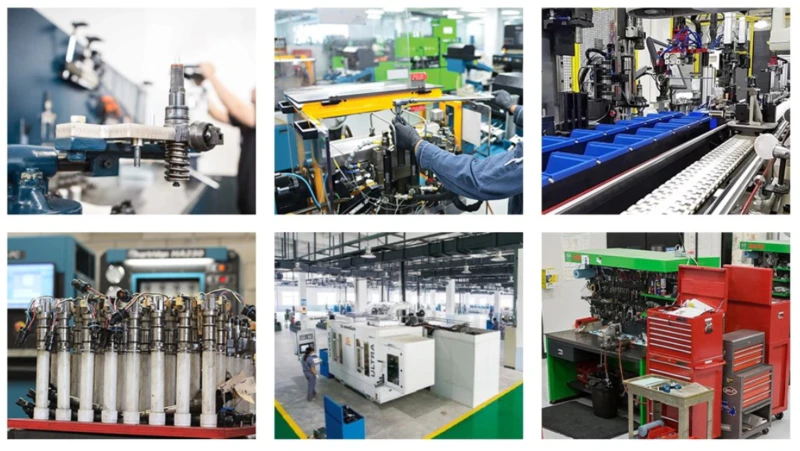
Ever-Power, established in 2003, has built a distinguished reputation as a global leader in the design and manufacture of high-quality driveshafts. With a state-of-the-art manufacturing facility and a dedicated team of experts, Ever-Power stands at the forefront of innovation in the driveshaft industry. Our commitment to excellence is reflected in our rigorous quality control processes and our use of advanced technologies to produce reliable, high-performance driveshafts.
Our driveshaft products are engineered to meet the diverse needs of various applications, including automotive, off-road vehicles, commercial trucks, and industrial machinery. Featuring superior strength, durability, and precision, our driveshafts are designed to efficiently transfer power from the engine to the wheels while minimizing vibrations and enhancing overall vehicle performance. The use of high-grade materials and advanced manufacturing techniques ensures that our driveshafts deliver exceptional performance even in the most demanding conditions.
Ever Power’s expertise in the driveshaft sector is underscored by our extensive experience and industry knowledge. Our products are trusted by leading automotive and industrial companies worldwide, demonstrating our influence and reliability in the market. We pride ourselves on our customer-centric approach, offering tailored solutions and unparalleled after-sales support to ensure optimal satisfaction.
Our service philosophy emphasizes continuous innovation and responsiveness to customer needs. We are dedicated to advancing driveshaft technology and maintaining the highest standards of quality and performance. With Ever Power, you can expect not only cutting-edge products but also comprehensive support and a commitment to driving your success forward.
Your One-Stop Handyman
Automotive industry
Passenger cars: used to transfer engine power to wheels, common in rear-wheel drive and four-wheel drive cars.
Commercial vehicles: Heavy vehicles such as trucks and buses require sturdy drive shafts to transmit large torque.
Railways and rail transit
Trains: Drive shafts are used to transfer power from engines or motors to wheels.
Subways and light rail: They also rely on drive shafts to maintain efficient and stable power transmission.
Aviation industry
Aircraft: In the drive systems of some aircraft, drive shafts are used to connect engines with other components.
Helicopters: Used to transfer power to rotors and tail rotors.
Marine and shipbuilding industry
Ships: The propulsion system of ships relies on drive shafts to transfer engine power to propellers.
Yachts: The engine system of yachts uses drive shafts to provide stable power output.
Industrial machinery
Heavy machinery: Such as excavators, cranes, etc. require drive shafts to transfer power to different operating parts.
Agricultural machinery: Such as tractors, combine harvesters, etc., also use drive shafts to connect engines with other moving parts.
Energy industry
Wind power generation: A drive shaft is used in the power transmission system of a wind turbine to transfer the rotational energy of the blades to the generator.
Power plants: In some generator sets, a drive shaft is used to transfer power to the generator.
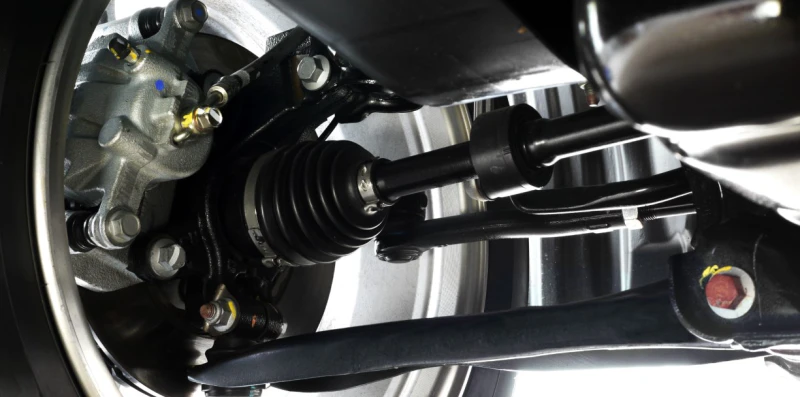
The difference between single-stage transmission shafts and multi-stage transmission shafts
| Feature | Single-Stage Transmission Shaft | Multi-Stage Transmission Shaft |
|---|---|---|
| Design | Consists of one continuous shaft | Composed of two or more connected shaft segments |
| Length | Shorter in length, typically used in vehicles with short wheelbases | Longer in length, designed for vehicles with longer wheelbases |
| Support | Requires less support, usually mounted directly between the transmission and differential | Requires additional support bearings or carrier bearings between segments |
| Application | Commonly used in rear-wheel drive cars, small trucks, and sports cars | Typically found in larger vehicles like trucks, buses, and commercial vehicles |
| Flexibility | Limited flexibility, less capable of accommodating chassis movement or length changes | Greater flexibility, can better accommodate movement and chassis flex |
| Vibration Control | Less effective in damping vibrations due to its simpler structure | Better vibration control with intermediate supports reducing resonances |
| Cost | Generally lower cost due to simpler design and fewer components | Higher cost due to additional components and complexity |
| Installation | Easier to install, with fewer components and simpler alignment requirements | More complex installation, requiring precise alignment of multiple segments |
| Maintenance | Requires less maintenance due to fewer components and joints | Requires more frequent maintenance checks on joints and support bearings |
| Weight | Typically lighter due to its single-piece design | Heavier due to the additional components and segments |
| Durability | High durability in simpler applications | High durability in complex applications, but dependent on maintenance |
| Usage in Extreme Conditions | Less suitable for vehicles operating in extreme or varied conditions | More suitable for vehicles in extreme conditions, as it allows for chassis flexibility |
Driveshaft for sale
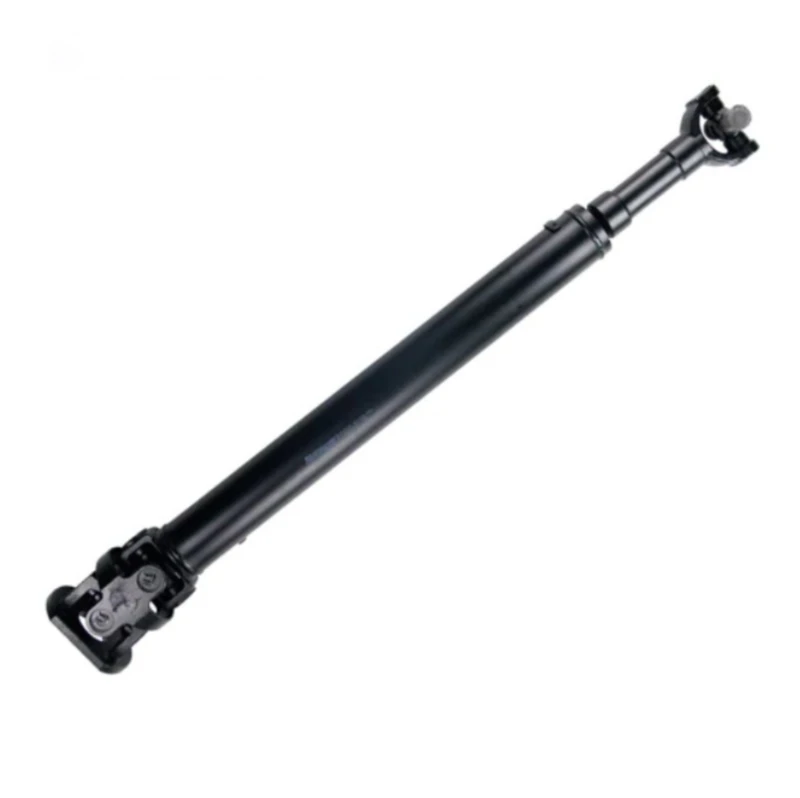
Driveshaft
37140-60380 Front Propeller Shaft for Toyota 4 Runnerprop Drive Shaft for Lexus Gx470
26107573493 Propeller Shaft/Drive Shaft for BMW 525 528 530 2006-2008 Drive Shaft
7L6521102p Universal Joint Shaft Drive Shaft for Volkswagen Touareg Porsche Cayenne Propeller Shaft
Tvb000090 Front Propeller Shaft Drive Shaft for Land Rover Freelander 1 Universal Joint Shaft
65-9305 Universal Joint Drive Shaft for Ford F250 Super Duty Propeller Drive Shaft 938-802
Types of Driveshaft
1. Solid Driveshafts:
Consists of a single, solid metal shaft
Suitable for shorter distances and lower power requirements
Typically used in lighter-duty applications
2. Tubular Driveshafts:
Hollow, cylindrical shaft design
Provides a balance of strength and weight reduction
Commonly used in passenger vehicles and light trucks
3. Slip Driveshafts:
Incorporates a sliding joint or spline to allow for length variation
Enables axle and suspension movement in vehicles
Commonly used in rear-wheel drive and all-wheel drive vehicles
4. Constant Velocity (CV) Driveshafts:
Equipped with constant velocity joints at one or both ends
Maintain a constant rotational speed despite changes in angle
Widely used in front-wheel drive and all-wheel drive vehicles
5. Universal Joint Driveshafts:
Utilize universal joints to accommodate angular misalignment
Provide a flexible connection between the driving and driven components
Commonly used in heavy-duty vehicles, industrial machinery, and marine applications
6. Cardan Driveshafts:
Similar to universal joint driveshafts but with a more complex design
Incorporate a Cardan joint to handle higher angles and torque loads
Often used in commercial vehicles, construction equipment, and agricultural machinery
7. Telescopic Driveshafts:
Designed with a sliding or telescoping section
Allows for changes in length to accommodate suspension travel
Commonly found in truck and trailer applications
8. Composite Driveshafts:
Manufactured using carbon fiber or other composite materials
Offer reduced weight and increased torsional stiffness
Used in high-performance and specialty applications
Driveshaft Materials
Steel:
Traditional and widely used material for driveshafts
Offers high strength, rigidity, and durability
Suitable for a wide range of applications, from light-duty to heavy-duty
Can be heat-treated to improve strength and wear resistance
Aluminum:
Provides a significant weight reduction compared to steel
Used in applications where weight savings is a primary concern, such as in high-performance and luxury vehicles
Offers good strength-to-weight ratio but may have lower torsional stiffness than steel
Composite Materials:
Typically made from carbon fiber, fiberglass, or a combination of both
Offer exceptional strength-to-weight ratio and improved torsional stiffness
Commonly used in high-performance, specialty, and aerospace applications
Require advanced manufacturing techniques and can be more expensive than metal driveshafts
Titanium:
Exceptionally strong and corrosion-resistant material
Used in applications where weight and corrosion resistance are critical, such as in aerospace and military vehicles
Offers a good balance of strength and light weight but can be more expensive than other options
Polymer Composites:
Consist of a polymer matrix (such as epoxy or polyurethane) reinforced with fibers (e.g., glass, carbon, or aramid)
Provide a cost-effective alternative to metal driveshafts in certain applications
Offer good strength-to-weight ratio and can be engineered to meet specific performance requirements
Components of Driveshaft
Shaft Tube:
The central, cylindrical component that transmits the rotational torque
Made of materials like steel, aluminum, or composite materials
May be solid or hollow (tubular) in design
Universal Joints (U-Joints):
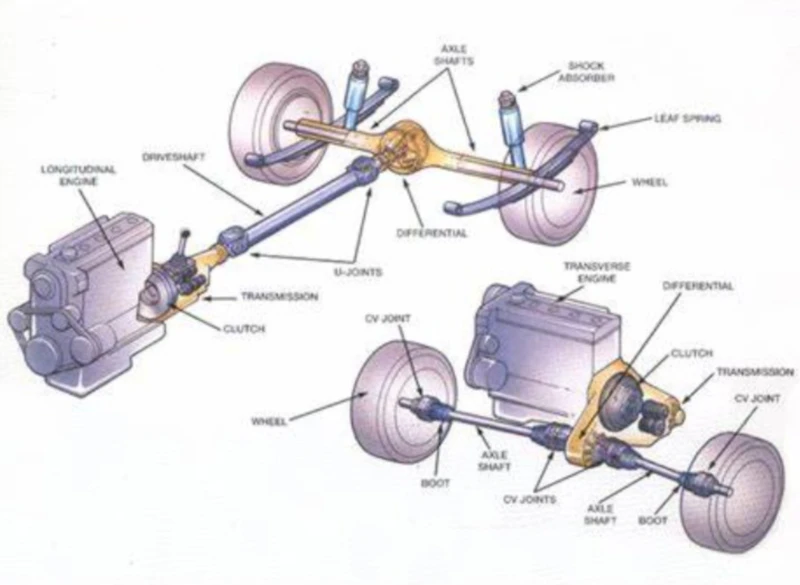
Allow the driveshaft to accommodate angular misalignment between the driving and driven components
Consist of a cross-shaped joint with needle bearings or ball bearings
Provide a flexible connection to enable smooth power transmission
Slip Yokes or Splines:
Enable the driveshaft to telescope or slide in and out to accommodate changes in length
Commonly used in rear-wheel drive and all-wheel drive vehicles to accommodate suspension movement
Center Bearings or Hanger Bearings:
Provide intermediate support for longer driveshafts
Help to reduce vibration and maintain alignment of the driveshaft
Balancing Weights:
Added to the driveshaft to improve dynamic balance and reduce vibrations
Helps to ensure smooth and efficient power transmission
Flanges or Yokes:
Attach the driveshaft to the transmission, differential, or other driven components
Typically feature splined or bolt-on connections
Protective Boots or Covers:
Protect the universal joints and other driveshaft components from environmental factors, such as dirt, moisture, and debris
Driveshaft Features

Strength and Durability
Ability to withstand high torque loads, impact forces, and torsional stresses
Made of materials like steel, aluminum, or composite materials to provide the necessary strength
Flexibility and Alignment
Incorporation of universal joints, Cardan joints, or slip joints to accommodate angular misalignment and changes in length
Allows for smooth power transmission despite changes in vehicle or equipment geometry
Vibration and Noise Reduction
Balanced design to minimize vibrations and ensure smooth, quiet operation
Use of intermediate bearings and damping mechanisms to reduce driveline noise
Corrosion Resistance
Protective coatings, treatments, or materials to resist corrosion from environmental factors
Ensures long-term reliability and durability in various operating conditions
Weight Optimization
Utilization of lightweight materials, such as aluminum or composites, to reduce the overall weight of the driveshaft
Particularly important in applications where weight savings are critical, such as in high-performance vehicles or aircraft
Spline and Flange Connections
Secure attachment points to the transmission, differential, or other driven components
Ensures reliable power transmission and minimizes the risk of driveshaft separation
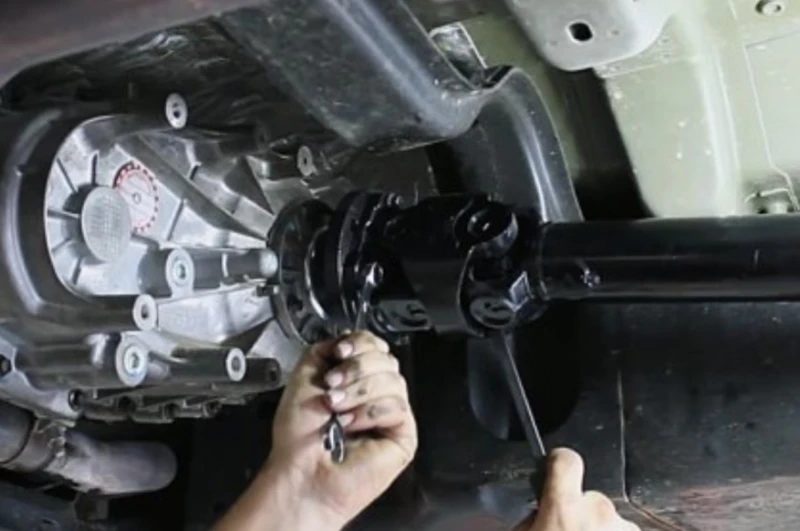
Driveshaft installation and maintenance
Installation:
Alignment:
Ensure the driveshaft is properly aligned with the transmission, differential, or other driven components
Check for any angular or parallel misalignment and make necessary adjustments
Proper alignment helps to minimize vibrations and prevent premature wear or failure
Correct Length:
Measure the required driveshaft length for the specific application
Ensure the driveshaft can accommodate changes in length due to suspension or chassis movement
Trim or select the appropriate length to avoid interference or binding
Secure Connections:
Properly attach the driveshaft to the flanges or yokes using the correct hardware (e.g., bolts, nuts, lock washers)
Tighten the connections to the specified torque values to prevent loosening or separation
Lubrication:
Apply the recommended lubricant to the universal joints, slip yokes, and any other moving components
Ensure the lubricant is compatible with the driveshaft materials and operating conditions
Maintenance:
Periodic Inspection:
Visually inspect the driveshaft and its components for any signs of wear, damage, or leaks
Check for cracks, corrosion, or excessive play in the universal joints or slip yokes
Lubrication and Greasing:
Regularly grease the universal joints and slip yokes according to the manufacturer’s recommendations
Replenish the lubricant to ensure proper lubrication and prevent premature wear
Balancing and Vibration Monitoring:
Periodically check the driveshaft’s dynamic balance and address any imbalance issues
Monitor the driveline for any excessive vibrations, which may indicate a problem
Replacement:
Replace the driveshaft or its components (e.g., universal joints, slip yokes) if they show significant wear or damage
Follow the manufacturer’s recommended replacement intervals to maintain reliability and safety
Why choose ever power?
1. High-quality products: Ever Power is committed to providing the highest-quality Driveshaft. Our products are precision-engineered and manufactured using advanced materials to ensure durability, reliability, and consistent performance.
2. Comprehensive Service: We pride ourselves on providing excellent customer service. Our professional team is ready to answer your questions, provide technical support, and provide solutions tailored to your needs.
3. Competitive Prices: Ever Power offers competitive prices without compromising quality. We believe in creating value for our customers and work hard to ensure our products fit every budget.
4. Excellent after-sales support: We know a product is only as good as the support you receive after purchasing it. Our company provides comprehensive after-sales services, including timely repair, replacement, and maintenance, ensuring that your Driveshaft is in optimal condition for a more extended period.
5. Rich product range: Ever Power provides a variety of Driveshaft shafts to meet different applications and requirements. We can provide you with the right product.